
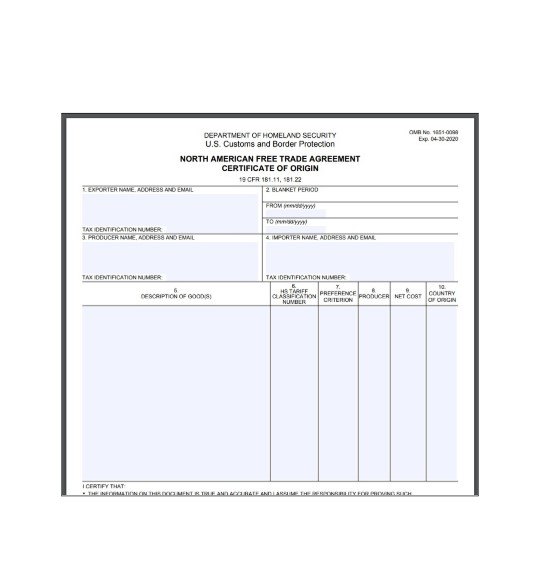
International trade agreements often require documentation that verifies where products are manufactured or sourced. One of the most recognized trade documents used in North American commerce was the NAFTA Certificate of Origin, commonly referred to as a NAFTA cert.
This document was used to confirm that goods qualified for preferential tariff treatment under the North American Free Trade Agreement between the United States, Canada, and Mexico. Proper documentation helped businesses reduce import duties and simplify customs processing for eligible products.
Why Certificates of Origin Matter in Trade?
Certificates of origin are important because they establish the manufacturing origin of imported or exported products. Customs authorities use these documents to determine whether goods qualify for reduced tariffs or other trade benefits under specific agreements.

A properly completed NAFTA cert provided detailed information about the exporter, producer, importer, and product classification. This information allowed customs officials to verify compliance with trade agreement requirements.
Without accurate documentation, businesses could face delays, penalties, or loss of tariff benefits during international shipments. As a result, trade compliance became an important part of supply chain management for manufacturers and exporters.
Information Included in a NAFTA Certificate
Trade documentation must contain accurate and verifiable product details. A standard NAFTA cert typically included product descriptions, tariff classification codes, producer information, and country of origin declarations.
The document also required exporters or producers to certify that the goods met the rules of origin established under the trade agreement. These rules determined whether a product contained sufficient North American manufacturing content to qualify for reduced tariffs.
Supporting records such as invoices, supplier declarations, and production data were often maintained to verify the accuracy of the certification if requested by customs authorities.
Accurate recordkeeping helped businesses avoid compliance issues and supported smoother border processing during international shipments.
Importance of Compliance and Documentation
Trade compliance plays a major role in international logistics and customs operations. Incorrect or incomplete documentation may lead to shipment delays, additional inspections, or unexpected import costs.
A properly prepared NAFTA cert helped businesses demonstrate compliance with trade regulations while reducing administrative complications at border checkpoints. Companies involved in manufacturing, distribution, and exporting often relied on trade specialists to ensure documentation accuracy.
Understanding tariff classifications and product sourcing was especially important for companies dealing with complex supply chains involving components manufactured across multiple countries.
In industries with high-volume imports and exports, accurate documentation also contributed to more predictable delivery timelines and cost management.
Transition From NAFTA to USMCA
The original North American Free Trade Agreement was later replaced by the United States-Mexico-Canada Agreement (USMCA). While the updated agreement introduced new trade requirements and documentation standards, many businesses still reference older terminology and procedures associated with NAFTA.
The historical role of the NAFTA cert remains important because it helped establish standardized trade documentation practices across North America. Understanding these processes continues to support businesses involved in customs compliance and international trade operations.
Many principles regarding origin verification, tariff classification, and documentation accuracy still apply under current trade agreements.
Conclusion
Trade documentation remains an essential part of international commerce, especially for businesses involved in cross-border shipping and customs compliance. Proper trade documentation is particularly important for industries that regularly export industrial equipment and machine part international markets.
A properly completed NAFTA helped companies verify product origin, qualify for tariff benefits, and support smoother customs processing under North American trade agreements.
Even as trade regulations evolve, understanding certificate requirements continues to play an important role in global supply chain operations.