
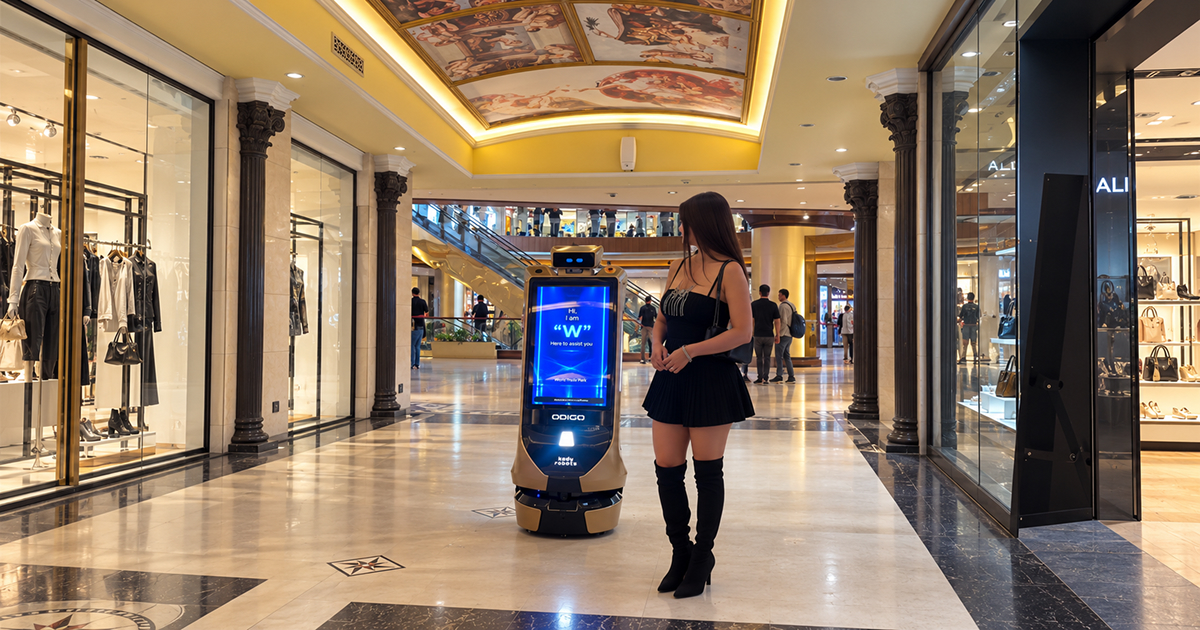
Product discovery is becoming one of the most important parts of the physical grocery experience. Shoppers may enter with a precise list, a broad meal idea, or only a category in mind. The challenge begins when they need to turn that intent into a physical destination inside a large store.
This is where robots for supermarket environments can add practical value. Customer-facing robotics can support product search, aisle discovery, guided navigation, promotional engagement, and human assistance. The objective is not to automate the entire trip. It is to reduce the friction between a shopper’s question and the next useful action.
FMI’s 2026 U.S. Grocery Shopper Trends research found that 69% of shoppers want an easy in-store experience and 69% want to find aisles or departments easily. It also found that 71% use digital technology while grocery shopping.

Why Is Product Discovery Becoming More Important?
A supermarket is not only a place where shoppers collect known items. Customers compare products, respond to promotions, discover alternatives, explore new categories, and move between digital and physical information during the same trip.
FMI describes grocery shopping as increasingly blended between store and screen. That makes robots for supermarket product discovery relevant because digital assistance can appear inside the physical journey instead of remaining only on a phone or fixed kiosk.
An Odigo, Supermarket Robot can be positioned around assistance, destination discovery, wayfinding, engagement, advertising, and human handoff.
What Does Autonomous Product Discovery Mean?
Autonomous product discovery does not mean a robot decides what a customer should buy.
It means technology can support structured parts of the discovery journey without requiring an employee to manually guide every request.
A shopper might search for a product category, identify a destination, request directions, or interact with a promotion. Robots for supermarket environments can support these steps while the shopper remains in control.
McKinsey’s 2026 grocery research found that 51% of surveyed consumers were willing to try assisted product search, while only 20% were willing to try fully automatic ordering without user review. This suggests that assistive AI is more acceptable to shoppers than technology that removes customer control.
How Can Robots Help Shoppers Find Products?
The most direct use case is search.
A shopper can select a product or category from an approved interface. If reliable store-location information is connected to the experience, the system can identify the relevant aisle, department, or destination.
A Grocery Store Wayfinding Robot can then connect product search with physical navigation.
The journey becomes:
Search → Match Destination → Guide → Arrive → Continue Shopping
For Kody Robots, this gives customer-facing robotics a clear role. The robot does not make the purchase decision. It helps the shopper reach the place where that decision can happen.
Why Is Wayfinding Essential to Product Discovery?
Search without navigation can leave a gap.
Knowing that an item is in a particular aisle is useful, but shoppers may still need help reaching it efficiently, especially in a large or unfamiliar store.
A Supermarket Wayfinding Robot can support movement between search and destination. This is one of the most practical Supermarket Wayfinding Robot Use Cases because the value is easy for shoppers to understand.
Robots for supermarket environments become more useful when they connect information with action. This is also why Wayfinding Robots in Supermarkets can contribute to a broader customer-experience strategy rather than functioning as isolated navigation devices.
How Does Aisle-Level Guidance Improve Discovery?
A Supermarket Aisle Navigation Robot can help shoppers move toward an aisle or configured product zone instead of only providing a broad department location.
Consider someone looking for a specialty ingredient. The shopper may know the product name but not whether it belongs in baking, international foods, condiments, or another category. Search can identify the configured destination while navigation supports the physical journey.
In this model, robots for supermarket product discovery reduce unnecessary searching without taking over the purchase decision.
How Can Robots Support Category Discovery?
Not every shopper searches for an exact product.
Someone may look for breakfast options, snacks, beverages, or baking supplies. A customer-facing robot can help structure that request and direct the shopper toward an appropriate configured area.
This makes a Supermarket Navigation Robot relevant to both known-item search and broader category discovery.
Kody Robots can use this model to connect approved information, destination search, wayfinding, and a clear route to human assistance.
What Happens When the Shopper Needs More Than Directions?
This is where automation needs clear limits.
A robot can support configured categories, destinations, and promotional information. It should not invent product claims, availability, dietary advice, or recommendations that are not supported by approved data.
A Supermarket Customer Assistance Robot therefore works best as part of a hybrid service model. Structured repetition can be supported digitally. Judgment, exceptions, trust, and complex service remain human responsibilities.
This balance allows robots for supermarket environments to make discovery easier without weakening the role of store associates.
How Can Product Discovery Connect With Retail Advertising?
Promotions are part of grocery discovery.
A shopper may notice a product because of a campaign rather than because it was on the original list. The challenge is turning awareness into an actionable in-store journey.
The comparison between Static Screens vs Advertising Robots in Supermarkets is therefore about more than where an advertisement appears. It is also about what the shopper can do next.
A customer-facing robot can support:
Promotion → Interest → Product Search → Wayfinding → Destination
This is where robots for supermarket environments can connect advertising with product discovery. The interaction can continue into information, navigation, QR engagement, or human assistance.
Why Does Mobility Matter?
A fixed kiosk can work well when customers know where to find it.
A mobile customer-facing robot serves a different role because it can operate within approved areas where shoppers are already moving and making decisions.
A shopper may decide to search for an item halfway through the trip after seeing a display or remembering something missing from the list. Robots for supermarket product discovery can make assistance more flexible because the interaction is not tied to one permanent point.
The business value is not movement by itself. The value is bringing useful assistance closer to moments of customer intent.
Can Product Discovery Reduce Repetitive Questions for Employees?
Store associates are often asked where products, departments, or services are located.
These are valid questions, but many are structured and repeatable. Customer-facing robots for supermarket environments can provide another option for these requests while employees remain available for product knowledge, policy decisions, complaints, and complex service.
The division is simple:
Technology supports structured requests. People handle judgment, exceptions, trust, and complex service.
How Can Product Discovery Improve Promotional Engagement?
Retail promotions can create interest without making the next step obvious.
A shopper may engage with an offer but not know where the related product is located. Product discovery can close that gap.
Kody Robots can position the customer journey so promotional content leads into information, navigation, QR interaction, or human help. This makes robots for supermarket product discovery relevant to both service and engagement.
What Should Retailers Measure?
A product-discovery deployment should be measured by outcomes rather than novelty.
Useful indicators can include successful searches, destination selections, completed guidance journeys, commonly requested categories, promotional interactions, human handoffs, uptime, and shopper feedback.
High interaction volume alone does not prove that robots for supermarket environments are improving the store.
Retailers should ask:
Did shoppers find products more easily?
And Did they reach the intended aisle?
Did promotional interest lead to a useful action?
Did the customer reach an employee when human help was required?
What Can Retailers Learn From Search Behavior?
Search behavior can also reveal friction in the store.
If customers repeatedly search for one category, signage or placement may need attention. And if shoppers frequently search for a promoted item, the campaign may be creating interest, but the physical route may be unclear. If many interactions require immediate staff assistance, the digital workflow may need refinement.
These signals can make robots for supermarket deployments another source of customer-experience insight when data is collected and used responsibly.
What Should Be Tested Before Deployment?
A pilot should begin with a defined customer problem.
Retailers should decide which products, categories, departments, and service points are searchable. They should determine how location information stays current, which areas the robot can use, how content is managed, and when staff handoff should occur.
Real store conditions matter. Carts, queues, temporary displays, seasonal changes, promotional islands, and busy aisles can all affect the experience.
Kody Robots can use a pilot to evaluate whether the customer journey remains useful under normal operating conditions.
Where Does the Odigo AI Robot Assistant Fit?
At the middle of the funnel, retailers need to move from general product-discovery concepts to a real customer-facing workflow.
An Odigo AI Robot Assistant can be positioned around assistance, wayfinding, advertising, engagement, and human handoff.
Kody Robots can keep the role focused. The stronger position is close to the shopper, helping connect questions, destinations, promotional engagement, and access to employees.
Why Should Product Discovery Remain Human-Assisted?
FMI’s 2026 research found that 48% of shoppers would miss being able to select products if they could no longer shop in person, while 22% would miss human connection.
That supports an assistive model for robots for supermarket environments.
The robot can help the shopper find the relevant area. The shopper still evaluates the products. Employees remain available for recommendations, special requirements, complaints, substitutions, and complex questions.
Automation helps with the journey without taking ownership of the decision.
Why Consider Kody Robots for Supermarket Product Discovery?
At the bottom of the funnel, retailers need a clear reason to evaluate customer-facing robotics.
Kody Robots can focus on a defined sequence:
Question → Search → Destination → Wayfinding → Engagement → Human Handoff
Kody Robots can concentrate on the points where shoppers regularly experience friction rather than presenting robotics as a solution to every store operation.
Retailers evaluating Kody Robots should ask whether shoppers understand the interface quickly, whether product and category locations remain accurate, whether guidance works within the store layout, and whether staff can take over smoothly.
Kody Robots should also be assessed on whether product discovery becomes simpler. The technology should reduce steps rather than introduce another complicated interface.
For Kody Robots, the strongest outcome is not simply a high number of interactions. It is more shoppers successfully moving from a question to the right destination.
That is where robots for supermarket product discovery become commercially meaningful.
Frequently Asked Questions
How can autonomous robots help shoppers discover products?
Customer-facing robots for supermarket environments can support product or category search, identify configured destinations, provide guidance, present promotional information, and connect shoppers with employees when human assistance is required.
Can a supermarket robot tell shoppers where a product is located?
Yes, when reliable product-location information is connected to the configured experience. The system can identify the relevant destination and support navigation through approved mapped areas.
Can supermarket robots recommend products?
A customer-facing robot can present approved information or configured discovery options. More complex recommendations requiring judgment, dietary understanding, or personal advice should involve an employee.
Are autonomous robots meant to replace supermarket employees?
No. The stronger model is assistive. Robots can support repeatable requests while employees handle recommendations, complaints, exceptions, accessibility needs, and complex service.
What are the main Supermarket Robot Use Cases for product discovery?
Common use cases include product search, category discovery, aisle guidance, department navigation, promotional discovery, destination search, and human handoff.
Why is wayfinding important after product search?
Search identifies what the shopper wants to find. Wayfinding helps turn that information into a physical journey toward the relevant aisle, category, department, or service point.
Conclusion
Autonomous product discovery is less about handing shopping decisions to machines and more about making the physical store easier to navigate.
Robots for supermarket environments can connect product search, category discovery, aisle guidance, promotional engagement, and human assistance.
For Kody Robots, customer-facing robotics can fit this opportunity through a focused experience built around assistance, navigation, engagement, and human handoff.
The future of supermarket product discovery is likely to remain hybrid. Shoppers will use digital tools, physical displays, employees, and robotic assistance at different moments.
The strongest technology will be the technology that helps customers find the right next step with less friction.
Sources
FMI, U.S. Grocery Shopper Trends 2026, was used for current research on in-store convenience, aisle finding, digital engagement, product selection, and human connection.
FMI, Digital Engagement Is Transforming Grocery Shopping, was used for the current physical-and-digital grocery journey context.

McKinsey & Company, The State of Grocery in North America, was used for current research on assisted product search and consumer preference for assistive rather than highly autonomous AI experiences.












Leave a Reply