
Deep learning is becoming increasingly important for businesses, research institutions, developers, and technology companies. From image recognition and natural language processing to generative AI and predictive analytics, deep learning applications require reliable computing infrastructure to process large datasets and complex mathematical operations.
Choosing the right server can be challenging, especially when comparing HPE servers with GPU-based server solutions. Businesses looking for a Deep Learning Server Malaysia solution need to consider processing performance, GPU compatibility, memory capacity, storage, scalability, and overall operating costs.
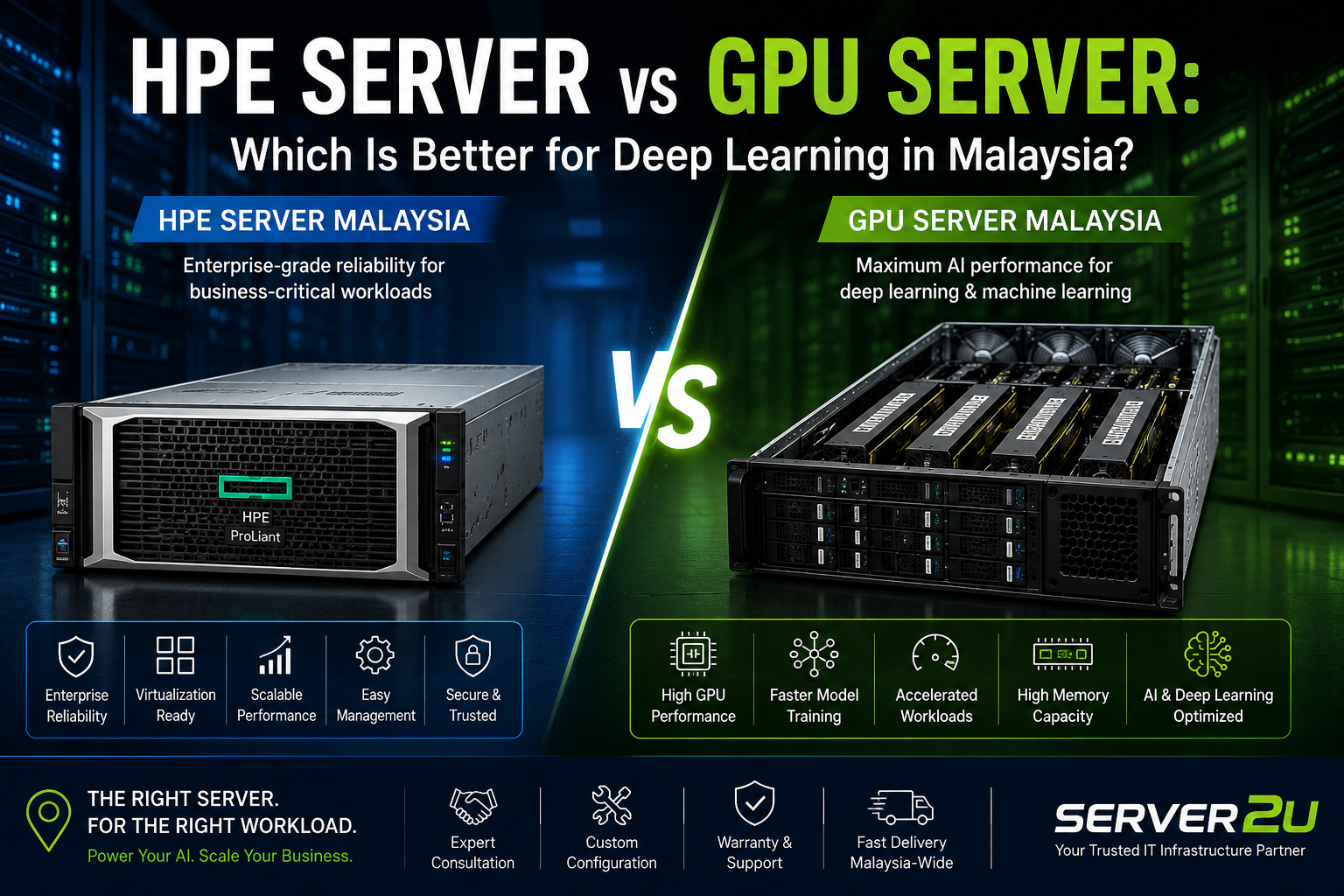
HPE (Hewlett Packard Enterprise) offers enterprise server platforms designed for a wide range of workloads, while GPU servers use graphics processing units to accelerate parallel computing tasks. Importantly, these categories are not mutually exclusive: certain HPE server models can also support GPUs for AI and deep learning workloads.

In this guide, we explain the differences between HPE servers and GPU servers, their advantages, and how to choose the right configuration for your business in Malaysia.
What Is an HPE Server?
An HPE server is an enterprise computing system developed by Hewlett Packard Enterprise. HPE offers server platforms designed to support business applications, virtualisation, databases, cloud infrastructure, and demanding computing workloads.
HPE ProLiant servers are among the company’s established server product families. Depending on the model and configuration, these systems can provide enterprise management features, expandable memory, storage options, and support for different processor configurations.
Key Benefits of HPE Servers
Reliable business operations: Enterprise server platforms are designed to support business-critical applications and workloads.
Flexible configurations: Depending on the model, businesses can select suitable processors, memory, storage, and networking components.
Virtualisation support: Compatible HPE servers can run virtual machines and multiple business applications.
Enterprise management: Supported management tools can help IT teams monitor hardware health, configure systems, and manage server operations.
Scalability: Businesses can select configurations that match current requirements while considering future expansion options.
When Should You Choose an HPE Server?
An HPE server may be suitable if your business needs a reliable platform for databases, enterprise applications, virtualisation, file services, or general computing.
For AI and deep learning, you should verify whether the particular HPE model supports the required GPU configuration, memory capacity, cooling, power delivery, and software environment.
What Is a GPU Server for Deep Learning?
A GPU server is a computing system equipped with one or more Graphics Processing Units (GPUs). GPUs are particularly useful for deep learning because they can perform many mathematical operations in parallel.
Deep learning models frequently involve large matrix calculations and repeated operations across neural networks. A suitable GPU server can accelerate these workloads compared with a CPU-only system, although actual performance depends on the hardware, model, software, and workload.
Common Applications of GPU Servers
GPU servers are commonly used for:
- Training deep learning and neural network models.
- Developing generative AI applications.
- Running large language models (LLMs).
- Image recognition and computer vision.
- Natural language processing.
- Scientific computing and advanced analytics.
- AI model inference and deployment.
Why GPU Memory Matters
GPU memory, also known as VRAM, determines how much model data and related workload information can fit on the GPU.
Insufficient GPU memory can prevent a model from running efficiently or require techniques such as model quantisation, smaller batch sizes, or distributing workloads across multiple GPUs.
Before purchasing a deep learning server, evaluate the model size, training requirements, dataset volume, and expected number of concurrent users.
HPE Server vs GPU Server: Key Differences
The main difference is that HPE identifies a server manufacturer and product platform, whereas GPU server describes a system configured with GPUs for accelerated computing.
An HPE server may itself be a GPU server if the specific model supports the required accelerator configuration.
| Feature | General-Purpose HPE Server | GPU Server |
|---|---|---|
| Main purpose | Business applications and enterprise computing | GPU-accelerated workloads |
| Processing | Primarily CPU-based unless accelerators are installed | Uses one or more GPUs alongside CPUs |
| Deep learning | Suitable for some CPU-based workloads; GPU support depends on the model | Often suitable for demanding AI training and inference |
| GPU support | Depends on model and supported configuration | Central part of the system design |
| Memory | System RAM, with capacity depending on the platform | System RAM plus GPU memory |
| Expansion | Depends on chassis and model | Depends on GPU slots, power, cooling, and chassis design |
| Common applications | Databases, virtualisation, business applications | AI training, deep learning, inference, and parallel computing |
| Cost | Varies by configuration | Can be higher for powerful multi-GPU systems |
The best option depends on the workload. A CPU-focused server may be sufficient for general business applications or smaller inference tasks, while GPU acceleration can provide significant benefits for many demanding deep learning workloads.
Which Server Is Better for Deep Learning in Malaysia?
There is no single answer for every organisation. The right choice depends on your AI project, available budget, performance targets, and infrastructure requirements.
Choose a General-Purpose HPE Server for CPU-Based Workloads
A suitable general-purpose HPE server may be appropriate when you need to:
- Run business applications alongside smaller AI workloads.
- Perform data preparation and preprocessing.
- Host databases and virtualisation environments.
- Run CPU-based machine learning tasks.
- Build a server infrastructure that may later be expanded, where supported.
However, if your deep learning framework relies heavily on GPU acceleration, a CPU-only server may not deliver the performance you require.
Choose a GPU Server for Intensive AI Training
A GPU server may be the better option when you need to:
- Train complex neural networks.
- Process large datasets with deep learning frameworks.
- Develop computer vision or generative AI applications.
- Run demanding AI inference workloads.
- Reduce processing time for workloads that benefit from parallel computing.
The number and type of GPUs should be selected according to model requirements, GPU memory, training time targets, and budget.
Consider an HPE Server with GPU Support
For businesses that prefer enterprise server platforms, an HPE server with supported GPU accelerators may offer a practical combination of enterprise hardware and accelerated computing.
Before purchasing, confirm the compatibility of the GPU, server chassis, power supply, cooling system, firmware, and required software. Not every HPE server supports every GPU.
Important Specifications to Consider Before Buying a Deep Learning Server
Selecting the right hardware requires evaluating the complete system rather than focusing on the processor or GPU alone.
1. GPU Performance and Compatibility
Check the GPU’s computing capabilities, memory capacity, supported software, and compatibility with the server. For multi-GPU systems, verify that the platform supports the intended number and type of accelerators.
2. CPU and System Memory
The CPU handles data preparation, system operations, and other tasks that support GPU workloads. Sufficient system RAM is important when processing large datasets or running multiple applications.
3. Storage Capacity and Speed
AI projects often use large datasets, model checkpoints, and training files. NVMe SSDs may be beneficial for workloads that require fast data access.
Consider both storage capacity and performance, along with a suitable backup strategy.
4. Power Supply and Cooling
High-performance GPUs can consume significant power and generate considerable heat. Ensure the server provides sufficient power delivery and cooling for the planned hardware configuration.

5. Networking and Expansion
Fast networking can be important when transferring large datasets or connecting multiple servers. Check expansion options, available slots, network interfaces, and storage connectivity before purchasing.
6. Software and Framework Compatibility
Confirm compatibility with your preferred operating system, GPU drivers, AI frameworks, libraries, and deployment tools. Software compatibility can directly affect productivity and performance.
7. Total Cost of Ownership
Consider the full cost of purchasing and operating the server, including hardware, electricity, cooling, maintenance, software, and technical support.
A system with a higher initial price may be more cost-effective over time if it significantly reduces processing time for frequently executed workloads.
For More information :- Click Here
How Much Does a Deep Learning Server Cost in Malaysia?
The price of a deep learning server in Malaysia depends on the hardware configuration and intended use. Entry-level systems for development and experimentation generally require fewer resources than enterprise AI systems designed for demanding training workloads.
Key factors that influence the cost include:
- GPU model and number of GPUs.
- GPU memory capacity.
- CPU performance and system RAM.
- SSD capacity and storage configuration.
- Networking requirements.
- Cooling and power supply specifications.
- Warranty and technical support.
Businesses should compare configurations based on their actual workloads rather than choosing a server based only on price.
For some projects, cloud GPU services may be more economical because they reduce the need for an upfront hardware investment. For consistent workloads, dedicated infrastructure may offer greater control over the environment and ongoing costs.
Common Mistakes to Avoid When Choosing a Server for Deep Learning
Buying a Server Without Checking GPU Compatibility
Confirm that the server supports your selected GPU, including its dimensions, power requirements, cooling, and interface.
Underestimating GPU Memory Requirements
A GPU with insufficient memory may struggle to run the intended model. Check the model’s memory requirements before finalising your configuration.
Ignoring Cooling and Electricity Costs
High-performance computing equipment can increase power consumption and cooling requirements. Include these expenses in your budget.
Choosing Hardware Based Only on Brand
A reputable server manufacturer does not automatically make every model suitable for deep learning. Compare the specifications and supported configurations of individual systems.
Overlooking Future Expansion
Consider whether your server can accommodate additional memory, storage, networking, or supported accelerators if your workloads grow.
Where to Find HPE and GPU Server Solutions in Malaysia?
Finding suitable hardware starts with understanding your processing requirements and comparing compatible server configurations.
Server2U provides a platform for exploring server hardware and IT infrastructure products. Businesses looking for an HPE Server Malaysia solution or a Deep Learning Server Malaysia configuration should review the available specifications, supported components, warranty terms, and technical support options before making a decision.
Before purchasing, identify your intended AI workloads, GPU memory requirements, expected dataset sizes, performance targets, and budget. These details can help you determine whether a general-purpose server, a GPU server, or an HPE platform with supported GPU accelerators is the right choice.
Visit Server2U to explore available server solutions:
Frequently Asked Questions (FAQs)
1. Which is better for deep learning: an HPE server or a GPU server?
For demanding deep learning workloads, a compatible GPU server is often preferable because GPUs accelerate many neural network operations. However, an HPE server configured with supported GPUs can also be an excellent option. The best choice depends on the specific model and workload.
2. Can HPE servers be used for deep learning?
Yes. Some HPE server models support GPU accelerators and can be configured for AI and deep learning. Always verify the supported GPU models, power requirements, cooling, and system compatibility.
3. What is a deep learning server?
A deep learning server is a computing system designed to train or run neural network models. It typically requires suitable processing power, sufficient memory, fast storage, and compatible software. GPU-equipped systems are commonly used for demanding workloads.
4. Do I need a GPU server to run machine learning?
No. Some machine learning tasks can run effectively on CPUs, particularly smaller datasets and traditional algorithms. GPU acceleration becomes more valuable for many deep learning models and computationally intensive workloads.
5. How much GPU memory is required for deep learning?
The required GPU memory depends on model size, batch size, numerical precision, dataset handling, and whether the task involves training or inference. Larger models may require high-memory GPUs or multiple GPUs.
6. Can I use a GPU server for generative AI?
Yes. GPU servers can support generative AI applications, including large language models and image generation, provided the hardware has sufficient memory, performance, and software compatibility.
7. What should I check before buying an HPE server in Malaysia?
Review the CPU, RAM, storage, expansion options, supported GPUs if needed, power supply, cooling, networking, warranty, and compatibility with your applications.
8. Is a GPU server more expensive than a standard server?
GPU servers can cost more because of the accelerators, power requirements, cooling, and supporting hardware. However, the overall value depends on how much the GPU accelerates your workload and reduces processing time.
9. Where can I find HPE servers in Malaysia?
You can explore available server products through suppliers such as Server2U. Confirm the specific model, configuration, availability, warranty, and technical support before purchasing.
Conclusion
Choosing between an HPE server and a GPU server for deep learning depends on the computing workload, performance requirements, budget, and future expansion plans.
A general-purpose HPE server can be suitable for enterprise applications, data processing, and CPU-based workloads. A GPU server is often better suited to intensive deep learning and AI applications that benefit from parallel processing. For businesses seeking both enterprise server features and AI acceleration, an HPE platform with compatible GPU support may provide a suitable solution.
Before investing, compare GPU memory, processing performance, system RAM, storage, cooling, software compatibility, and total cost of ownership.
Looking for the Right Deep Learning Server in Malaysia?
Explore server solutions at Server2U to find hardware that matches your AI workload, business requirements, and budget.
Whether you need an HPE server for enterprise computing or a GPU-equipped system for deep learning, compare specifications carefully to build a reliable and scalable infrastructure.
Visit Server2u to explore server hardware and find a solution for your business.