
The internet is crowded because every day, writers publish new articles, businesses launch new websites, and brands compete for the same attention on Google, social media, newsletters, and AI-powered search. Simply having a website is no longer enough, so you need to give people multiple reasons and opportunities to discover you.
That is why writers and businesses are increasingly exploring Guest post sites 2026, industry publications, social platforms, search optimization, and other content distribution channels. The goal is not to appear everywhere at once. Instead, it is to build a consistent online presence in places where your target audience already spends time.
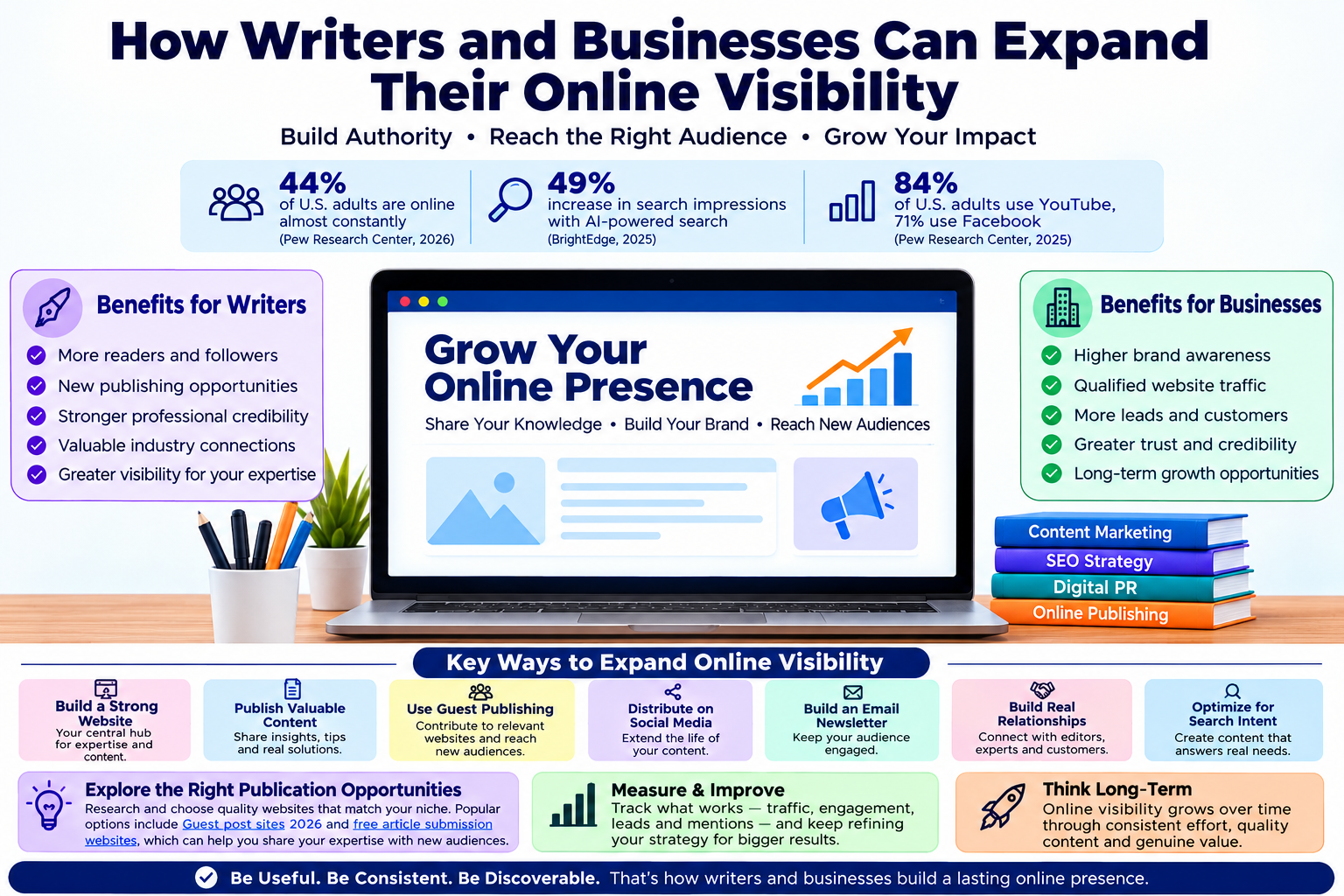
The opportunity is significant, particularly in the United States. Pew Research Center’s 2026 data shows that 44% of U.S. adults say they are online almost constantly, while another 41% go online several times a day. In other words, your audience is already online. The real challenge is getting noticed.
For writers, greater visibility can lead to more readers, publishing opportunities, professional relationships, and authority. For businesses, it can support brand awareness, qualified traffic, leads, and customer trust. However, visibility does not come from publishing random content everywhere. It comes from being useful, consistent, credible, and easy to find.
Why Online Visibility Matters More Than Ever
Online visibility is the ability of people to discover your name, business, content, products, or expertise across digital channels.
Think about a potential customer searching for a service. They might discover a company through Google, see its social media profile, read an article written by one of its team members, watch a YouTube video, and then visit the company’s website.
The journey is rarely linear.
That is why relying on a single platform is risky. Search algorithms change. Social media trends disappear. Advertising costs fluctuate. However, a strong digital presence built across several relevant channels gives writers and businesses more opportunities to be discovered.
BrightEdge reported in 2025 that total search impressions increased by more than 49% after the emergence of AI-powered search, suggesting that search behavior is expanding rather than simply disappearing. At the same time, its research found that traditional organic search remained a major source of referral traffic and conversions.
Therefore, the smart approach is not to abandon SEO for AI or social media. It is to build a broader visibility strategy.
Start With a Clear Audience and Message
Before publishing anything, determine exactly who you want to reach.
A writer might want to reach:
- Editors and publishers
- Industry professionals
- Potential clients
- Students or learners
- Readers interested in a specific subject
A business may want to reach:
- Local customers
- B2B decision-makers
- Online shoppers
- Industry professionals
- Existing customers
Once you understand your audience, your content becomes much easier to plan.
For example, a U.S.-based small business selling accounting software should not try to appeal to everyone interested in technology. It could focus on small-business owners, freelancers, and finance teams that need easier accounting solutions.
The narrower the audience, the easier it becomes to create relevant content.
Visibility without relevance is just noise. The goal is not to reach everyone; it is to become recognizable to the right people.
Build a Website That Gives People a Reason to Stay
Your website should be the foundation of your online presence.
Social media profiles and third-party publications are useful, but you do not completely control them. Your website gives you a central place to explain your expertise, publish original content, showcase your work, and guide visitors toward an action.
For writers, a strong website can include:
- An author biography
- Writing portfolio
- Published work
- Areas of expertise
- Contact information
- Testimonials
- Helpful articles
For businesses, the structure may include:
- Clear service or product pages
- About page
- Customer reviews
- Case studies
- Educational content
- Contact or booking options
- Frequently asked questions
Also, do not ignore technical basics. Your pages should load properly, work on mobile devices, use descriptive titles and headings, and provide a clear internal linking structure.
Good content cannot compensate for a website that is difficult to use.
Publish Content That Demonstrates Expertise
Creating content simply because you need to “post something” is a weak strategy.
Instead, create content that demonstrates what you know.
Google’s guidance emphasizes people-first content that provides original information, analysis, or useful expertise. It also recommends thinking about the “Who, How, and Why” behind content and making authorship and experience clear where appropriate.
That makes E-E-A-T particularly useful when planning content:
Experience
Show that you understand the subject through examples, observations, processes, or lessons learned.
Expertise
Explain the subject accurately and demonstrate genuine knowledge.
Authoritativeness
Build recognition through credible publications, references, professional profiles, and industry relationships.
Trustworthiness
Be transparent, accurate, and honest. Cite data and correct mistakes rather than hiding them.
For example, instead of publishing “10 SEO Tips Everyone Should Know,” a writer could publish “What I Learned After Auditing 50 Small Business Websites.”
The second idea has a much stronger experience component.
Use Guest Publishing to Reach Established Audiences
One of the most effective ways to expand visibility is to contribute to websites that already have an audience.
Guest blogging allows writers and businesses to introduce their expertise to people who may never have discovered them otherwise. HubSpot describes guest blogging as a strategy that can help businesses build authority and reach new audiences, while its current editorial guidelines emphasize real expertise, useful insights, credible sources, and original perspectives.
However, there is a major difference between strategic guest publishing and mass article submission.
Do not create one article and distribute it to dozens of unrelated websites.
Instead:
- Identify relevant publications.
- Study their audience.
- Read their editorial guidelines.
- Research topics they have not covered well.
- Pitch a useful idea.
- Create an original article.
- Follow their formatting and linking requirements.
- Promote the published piece afterward.
This approach is slower, but it creates a much stronger digital footprint.
Choose Publication Opportunities Carefully
If you search for free article submission websites, do not automatically assume that every free platform is worth using.
Free access is not the same as quality.
Before submitting, consider:
- Is the website relevant to your industry?
- Does it have a real audience?
- Is the content professionally edited?
- Are articles original?
- Does the website publish useful information?
- Does it have clear authorship?
- Are there excessive promotional links?
- Does the site appear to exist mainly for backlinks?
A low-quality website may accept almost anything, but that does not mean being published there will improve your reputation.
Ahrefs recommends focusing on relevant, high-quality websites and notes that guest blogging can help build relationships, expose brands to new audiences, and establish thought leadership.
Therefore, quality should always come before submission volume.
Create Content Around Search Intent
SEO is still an important part of online visibility, but modern SEO requires more than inserting keywords into an article.
First, understand why someone is searching.
For example:
- “best accounting software for freelancers” suggests comparison or purchase research.
- “how to create an invoice” suggests a need for instructions.
- “what is content marketing” suggests informational intent.
- “digital marketing agency near me” suggests local commercial intent.
Your content should satisfy that intent as directly as possible.
For instance, if your target audience searches for “how to improve local SEO,” do not spend the first 700 words explaining what SEO means. Give readers the practical steps they came for.
This improves user experience and makes your content more useful.
Repurpose Strong Content Across Channels
Creating content takes time. Fortunately, one strong piece can become several smaller assets.
Suppose a business publishes a detailed guide about improving customer retention.
That single article could become:
- A LinkedIn post
- Five short social posts
- An infographic
- A short video
- An email newsletter
- A podcast discussion
- A presentation
- Several FAQ answers
Writers can use the same approach with published articles. A useful guest post can become a portfolio sample, a discussion topic, a social post, or the foundation for another original article.
However, repurposing does not mean copying the same content everywhere. Adapt the idea to the platform.
Use Social Media as a Distribution Channel
Social media can help extend the life of content beyond search engines.
Pew Research Center’s 2025 research found that 84% of U.S. adults use YouTube, 71% use Facebook, and half use Instagram.
Those numbers show why social distribution can matter for U.S.-focused writers and businesses.
But you do not need to maintain ten social accounts.
Choose platforms based on your audience.
For example:
- LinkedIn can be valuable for B2B professionals and thought leadership.
- Instagram can work well for visual brands and creators.
- YouTube can support educational and demonstration-based content.
- Facebook can still be useful for broad consumer audiences and communities.
- TikTok can help brands reach audiences interested in short-form educational or entertainment content.
Consistency matters more than being everywhere.
Build Relationships, Not Just Backlinks
One of the biggest mistakes in online visibility is measuring success only through links.
A publication relationship can be much more valuable than a single backlink.
When you contribute genuinely useful content, you can build relationships with:
- Editors
- Journalists
- Business owners
- Industry experts
- Creators
- Other writers
- Potential partners
Those relationships can lead to interviews, collaborations, podcast invitations, speaking opportunities, referrals, and future publishing opportunities.
In fact, reputable publications often have strict rules against content that looks like a link-building campaign. HubSpot’s editorial guidelines, for example, explicitly state that it will not publish content that may be construed as a link-building scheme and expects contributors to bring real expertise and original value.
So build relationships first. Links should be a natural byproduct of useful publishing.
Make Your Content Trustworthy
Visibility without trust does not create long-term results.
Whenever you make an important claim, support it with evidence.
Use:
- Government data
- Academic research
- Established industry reports
- Original research
- Expert interviews
- Reliable company data
Also, provide author information where appropriate.
A clear byline can help readers understand who created the content. Google specifically recommends making authorship clear and providing background information about the creator when appropriate.
Likewise, do not hide behind vague claims such as “experts say.” Tell readers who the expert is and where the information came from.
Avoid the Trap of Publishing Too Much
More content does not automatically mean more visibility.
In fact, publishing large quantities of mediocre content can make your website harder to manage and your brand harder to trust.
Google’s people-first guidance warns against producing lots of content across many topics simply in hopes that some of it will perform in search.
Instead, create a manageable publishing system.
A practical monthly plan might include:
- 2–4 high-quality website articles
- 2 guest-post pitches
- 8–12 social posts
- 1 email newsletter
- 1 content update or refresh
- Regular engagement with industry communities
The exact numbers are less important than consistency and quality.
Measure What Actually Matters
Online visibility should be measurable.
Track metrics such as:
- Organic impressions
- Organic clicks
- Referral traffic
- Branded searches
- Social engagement
- Email subscribers
- Leads
- Conversion rate
- Published guest posts
- Mentions and citations
- Returning visitors
For writers, also track:
- Portfolio views
- Editor responses
- Guest-post acceptance rate
- Speaking or interview invitations
- New professional connections
Do not celebrate a traffic spike if it produces no meaningful engagement.
A smaller audience that trusts your work can be far more valuable than thousands of visitors who leave immediately.
Create a Long-Term Visibility System
The strongest online presence is built through repetition.
- research a topic.
- publish something genuinely useful.
- distribute it.
- engage with readers.
- build relationships.
- Measure the result.
- Then you improve the next piece.
- That cycle creates momentum.
For businesses, this can gradually turn a website into a trusted resource. For writers, it can transform individual articles into a recognizable professional identity.
Online visibility is not a single campaign. It is the accumulated result of being useful, credible, discoverable, and consistent over time.
Final Thoughts
Writers and businesses do not need to dominate every platform to become visible online. They need a focused strategy that connects quality content with the right audience.
Start with a clear message. Build a useful website. Publish content that demonstrates real expertise. Contribute to relevant publications. Explore free article submission websites carefully rather than blindly. Use social media to distribute your best work, and optimize content around genuine search intent.
Most importantly, do not confuse activity with progress.
Publishing 100 weak articles will not necessarily build authority. Sending hundreds of generic guest-post pitches will not make editors trust you. Creating dozens of social posts without a clear audience will not automatically generate customers.
Instead, focus on fewer, stronger actions.
Create something worth reading.
Publish it somewhere worth being seen.
Then give the right people a reason to care.
That is how online visibility becomes more than a vanity metric. It becomes a long-term asset for your reputation, audience, and business.