

Imagine investing heavily in a CTV campaign. Now imagine finding out that a single device triggered over 7,600 ad requests in just one day.
Pause for a second.
No human watches the same ad thousands of times in a day. So, if this is happening, something is clearly wrong.

Most advertisers set up a frequency cap, assuming it will limit how often an ad is shown to one viewer. But what if that control is not working properly? What if your ads are still repeating on the same devices while you believe you are expanding your reach?
This is where the real problem begins, and most brands don’t even realize it’s happening. So, if you are an advertiser who is running OTT or CTV campaigns, this blog will help you explore the problem with frequency capping breaches and what solution you need for it.
The Problem: When Frequency Capping Looks Fine — But Isn’t
During a CTV campaign for an Indonesian brand, an ad fraud solution partner conducted a deeper analysis of ad delivery data.
On the surface, nothing looked wrong. The campaign dashboard was showing strong activity; more than 6 million ad requests had been generated, impressions were steadily increasing, and the budget was being spent exactly as planned. The reach numbers also appeared stable, giving the impression that the ads were being delivered smoothly to a wide audience.
For any advertiser reviewing these metrics, it would feel like the campaign was performing well. There were no obvious warning signs, no sudden drops, and no unusual spikes that would immediately raise concern. Everything looked healthy — at least from the top-level view.
But when the partner examined how ads were being distributed at the device level, the pattern changed.
They discovered:
- 15.86% of impressions had crossed the intended frequency cap
- More than 950,000 impressions had to be blocked due to excessive repetition
- One single device generated 7,600+ ad requests in a single day
- Around 0.61% of traffic came from suspicious IP sources, such as VPNs and data centers.
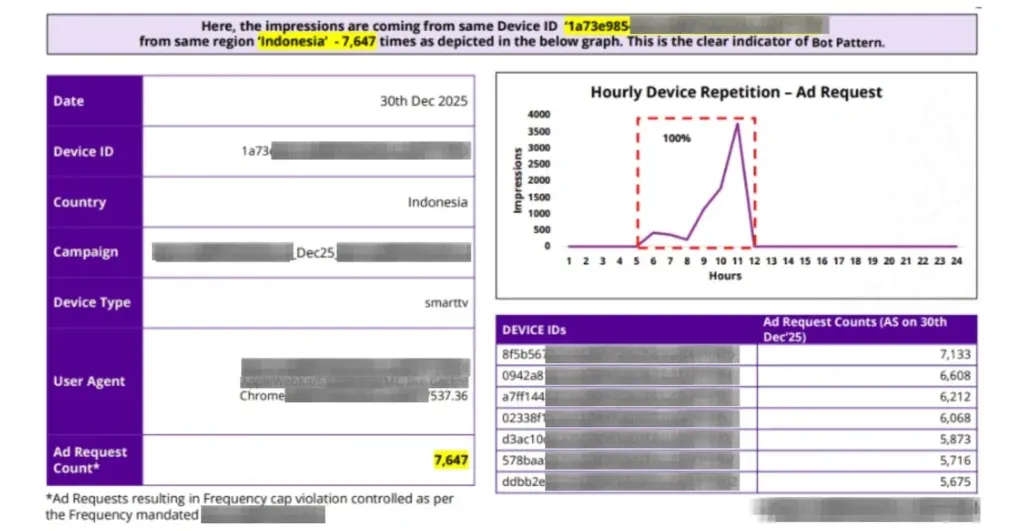
What does this actually mean?
It means a small group of devices were receiving the same ad over and over again. Instead of the campaign reaching new households, it was repeatedly targeting the same screens.
This creates multiple hidden issues:
- The budget gets consumed without expanding audience reach
- Reported reach may look larger than actual unique exposure
- Viewers may experience ad fatigue
- Campaign performance appears inflated
The problem with frequency capping breaches is that they are not always visible in standard reports. You may see strong numbers — but those numbers might not represent real, diverse viewers. And that’s the danger.
The Solution: Active Monitoring of Frequency Capping Breach
After identifying the issue, the ad fraud solution partner didn’t just rely on the platform’s default controls. They implemented independent monitoring at the ad request level.
In simple language, this means every time a device requested an ad, it was checked before being served.
Here’s what they focused on:
- Tracking how many times each device had already seen the ad
- Identifying devices generating unusually high ad requests
- Blocking impressions that exceeded the defined frequency limit
- Filtering traffic from suspicious IP environments
- Validating impressions in real time instead of post-campaign
In this case, once proper filtration and frequency enforcement were applied, the brand saw measurable results.
- 691,691 impressions were validated and served cleanly
- Video engagement remained strong and stable
- Traffic was properly validated before ads were delivered
Why is this important?
Because setting a frequency cap inside a buying platform does not always guarantee it is enforced perfectly across every environment. Technical gaps, device ID inconsistencies, or manipulated bot traffic can bypass limits.
By independently validating exposure, the solution ensured:
- No device saw the ad beyond the allowed limit
- The budget was redirected toward new viewers
- Repetitive impressions were stopped before they consumed spend
- Distribution became more balanced across households
For advertisers, this means gaining control again. Instead of assuming frequency is managed, you actively ensure it is.
How Has This Process Benefited Advertisers?
For advertisers, the lesson is very simple: just setting up a frequency cap is not enough. You may choose a limit, but if no one is checking whether that limit is actually being followed when the ad is shown, the setting becomes meaningless.
When frequency is properly monitored in real time, CTV campaigns become more efficient and more trustworthy. Here’s how these benefit advertisers:
1. You Stay in Control of How Often Your Ad Is Shown
Before an ad appears on a screen, the system checks whether that device has already seen it too many times. If it has, the ad is not shown again. This keeps your campaign under control and avoids unnecessary repetition.
2. Your Budget Is Not Spent on the Same Few Screens
Sometimes, a small number of devices end up seeing the ad again and again. Without proper monitoring, this can quietly eat up your budget. By tracking exposure at the device level, you can make sure your ads are reaching more households instead of repeating on the same screens.
3. Your Reach Becomes More Genuine
If repetition and suspicious traffic are not filtered out, your numbers may look bigger than they actually are. When both frequency and traffic quality are checked together, you get cleaner data. This means your ads are reaching real viewers, not inflated impressions.
4. Viewers Don’t Get Irritated
No one likes seeing the same ad too many times. Balanced exposure keeps the viewing experience comfortable. This protects your brand image and keeps engagement healthy.
5. You Make Better Campaign Decisions
When you clearly understand how often your ads are being shown and to whom, you can adjust your strategy. You can improve targeting, control repetition better, and use your budget more wisely.
Conclusion
Running a CTV campaign should help you reach new households, not repeatedly show ads to the same few devices.
As seen in this case, everything looked fine on reports, but hidden frequency breaches were quietly affecting performance. Once the Indonesian brand partnered with a smarter and advanced ad fraud detection expert like mFilterIt and leveraged its ad traffic validation solution, Valid8, repetitive impressions were filtered, traffic was validated, and reach became more genuine and balanced.
The result? Cleaner delivery, smarter budget usage, and more reliable campaign outcomes.
The bottom line is simple: setting up a frequency cap isn’t enough. You need active monitoring and proper validation to make sure your ads reach real viewers, the right number of times. Because in CTV and OTT advertising, real control leads to real results.
Key Takeaways for CTV Advertisers
Another important point advertisers should consider is that frequency control becomes even more critical during high-demand advertising periods, such as major sporting events, seasonal sales, or large digital campaigns. During these times, ad requests increase significantly across CTV and OTT platforms, which can make frequency management more difficult if proper monitoring is not in place.
When multiple platforms, devices, and programmatic exchanges are involved, small technical gaps can allow ads to repeat more often than intended. Without visibility into how frequently ads are actually being served at the device level, advertisers may unknowingly waste budget on repeated impressions instead of expanding reach.
Continuous monitoring, traffic validation, and intelligent filtering help ensure that campaigns remain balanced, budgets are used efficiently, and ads are distributed across a wider and more relevant audience. This approach ultimately helps advertisers maintain better campaign performance while protecting the overall viewing experience for audiences.
The way this post is written makes the whole discussion feel very easygoing and clear, while also keeping enough meaning in the topic to make readers interested in sharing their own opinions and continuing the conversation further.
meilleur casino en ligne retrait immediat