
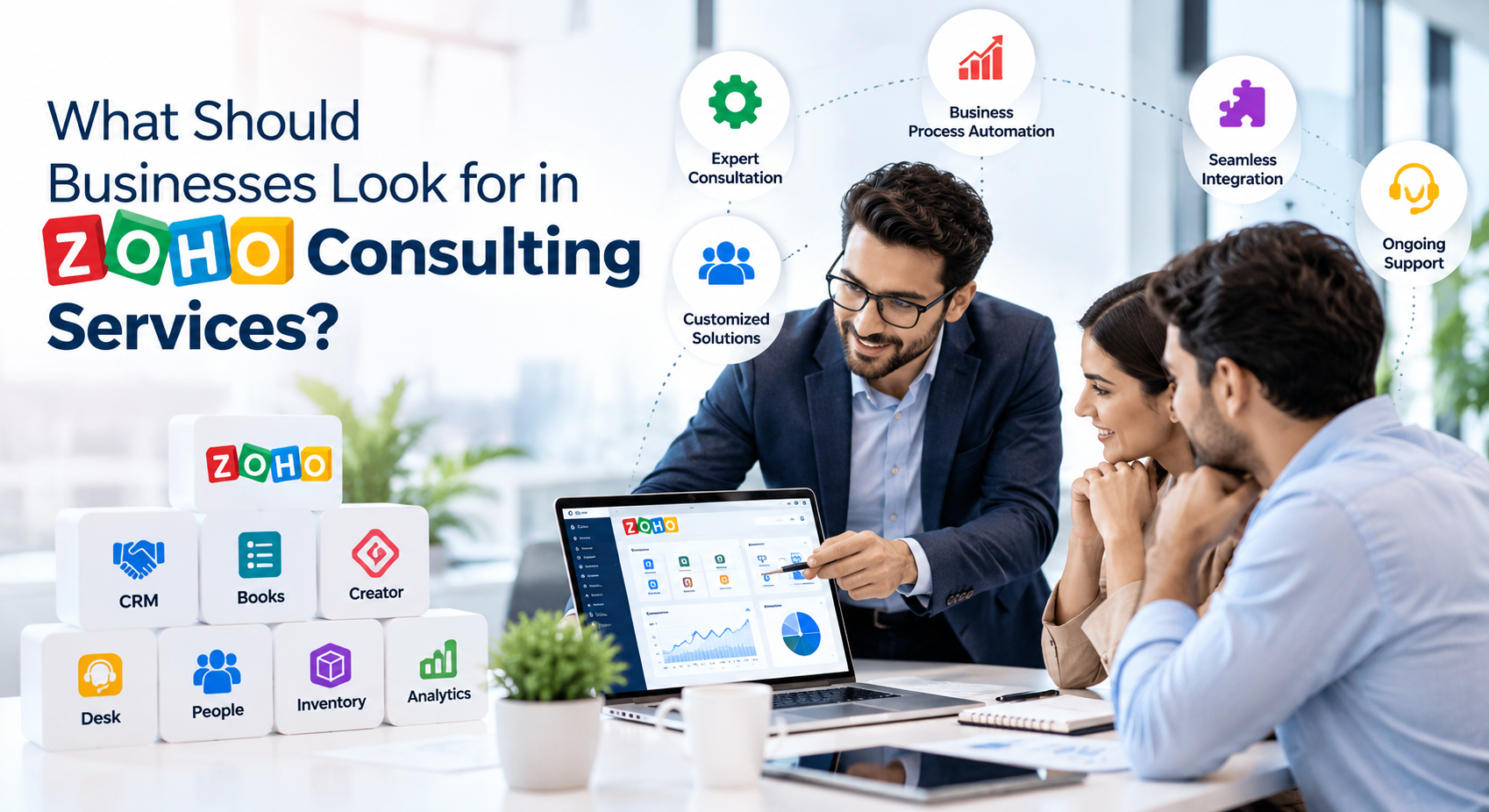
Running a business involves managing customers, sales, marketing, finances, and daily operations. When these activities are handled through separate tools, employees may spend more time updating records, searching for information, and correcting mistakes than focusing on business growth. This is where Zoho can help. However, choosing the right applications and configuring them to match your business needs requires careful planning and technical knowledge.
Zoho Consulting Services help businesses select, configure, integrate, and optimize Zoho applications according to their workflows. Whether you want to improve customer relationship management, automate marketing campaigns, simplify accounting, or connect different departments, the right consulting partner can help you get more value from your technology investment.
But how do you choose a consultant who understands your business rather than simply installing software?
In this guide, we explain the important factors to consider when selecting a Zoho consulting partner, the services to evaluate, common mistakes to avoid, and how Vision Infotech can support your business with practical technology solutions.
What Are Zoho Consulting Services?
Zoho Consulting Services involve helping businesses implement and manage Zoho applications based on their operational requirements. A consultant studies your existing processes, identifies problems, recommends suitable applications, and configures the software to support your business goals.
Zoho offers applications for customer relationship management, accounting, email marketing, project management, human resources, analytics, and business automation. However, every business uses these tools differently. A growing service company may need better lead tracking, while an accounting firm may want to streamline invoices, expenses, and financial reporting.
A qualified consultant helps connect these requirements with the right Zoho solutions.
What Does a Zoho Consultant Actually Do?
A Zoho consultant may help with:
Business process analysis: Understanding your current workflows and identifying areas that need improvement.
Application selection: Recommending suitable Zoho products based on your needs and budget.
Implementation and customization: Configuring modules, fields, dashboards, layouts, and workflows.
Data migration: Moving existing customer, financial, or operational records into the appropriate applications.
System integration: Connecting Zoho with accounting platforms, email tools, websites, and other business systems.
Employee training: Helping your team understand how to use the software correctly.
Ongoing support: Resolving issues, improving workflows, and adapting the system as your business grows.
The goal is not simply to introduce new software. It is to make everyday business activities easier to manage.
10 Important Things to Look for in Zoho Consulting Services
Choosing a consulting partner requires more than comparing prices. You need a team that understands your business processes, communicates clearly, and can deliver a solution that remains useful as your company grows.
Here are ten important factors to evaluate.
1. Experience With Your Business Requirements
Every business has different operational challenges. A retail company may need inventory visibility and customer purchase history, while a professional services firm may need project tracking, lead management, and automated follow-ups.
Before hiring a consultant, ask about their experience with similar requirements.
A good consultant should understand your current process before recommending an application. They should also explain how the proposed solution will address your specific problems.
For example, imagine a US-based consulting company that receives leads through website forms, email, and referrals. Its sales team stores these contacts in separate spreadsheets. As a result, some prospects never receive a follow-up.
An experienced consultant could configure Zoho CRM to centralize lead records, assign leads to sales representatives, and create reminders for follow-ups.
When evaluating Zoho Consulting Services, ask for relevant project examples, implementation details, and measurable outcomes where available. These details help you understand whether the consultant can handle your requirements.
2. Strong Knowledge of Zoho Applications
Zoho provides several applications, and selecting the right combination can make a significant difference to your results.
Depending on your requirements, you may need:
Zoho CRM: To manage leads, customer information, sales activities, and pipelines.
Zoho Books: To manage invoices, expenses, accounting records, and financial reporting.
Zoho Creator: To build custom business applications and automate specific processes.
Zoho Campaigns: To manage email marketing campaigns.
Zoho Analytics: To analyze business data and prepare reports.
Zoho Desk: To organize customer support requests.
Zoho Projects: To manage tasks, project schedules, and team collaboration.
Zoho One: To access a broader suite of business applications under one offering.
A consultant should explain which applications are relevant to your business and why. They should not recommend every available product when a smaller setup would meet your needs.
Ask whether the team has hands-on experience with the particular applications, integrations, and customizations your project requires.
3. Customization That Matches Your Workflow
Standard software features do not always fit the way a business operates. You may need custom fields, approval processes, specific reports, automated notifications, or role-based access.
This is why customization experience matters when comparing Zoho Consulting Services.
For example, a real estate company might want to track property inquiries, viewing appointments, client preferences, and deal progress in one place. A consultant can configure the relevant CRM fields and workflows so agents can manage these activities without maintaining separate spreadsheets.
What Should You Ask About Customization?
Before starting the project, discuss:
Which processes can be handled through standard features?
Which requirements need custom functions or integrations?
How will customizations affect future upgrades and maintenance?
Who will document the configuration?
Can the system be adjusted when your requirements change?
A reliable consultant should recommend the simplest practical solution. Excessive customization can increase costs and make future maintenance more difficult.
4. Integration With Your Existing Business Tools
Many companies already use accounting platforms, email services, websites, payment systems, or other applications. Replacing every tool may be unnecessary and expensive.
Instead, you may be able to connect your existing systems with Zoho.
For example, Zoho QuickBooks Integration Services can help businesses evaluate ways to connect customer, sales, and financial workflows between the relevant platforms. The exact integration method depends on the products, available connectors, and the information that needs to be synchronized.
A consultant should explain what data will move between systems, how often synchronization will occur, and how errors or duplicate records will be handled.
If your company uses Xero, you may also need to evaluate Xero-to-Zoho integration or migration options.
When reviewing a provider, ask whether it has experience with API integrations, third-party connectors, data mapping, and synchronization troubleshooting. You should also clarify which system will serve as the main source for each type of record.
5. Marketing Automation Capabilities
Marketing teams often manage email campaigns, customer lists, lead nurturing, and follow-up activities manually. These tasks become harder as the number of prospects increases.
A suitable consultant can help identify opportunities for automation using the appropriate Zoho applications.
Businesses looking for Zoho Marketing Automation in USA should evaluate whether the consultant understands lead segmentation, campaign workflows, customer journeys, conversion tracking, and consent requirements.
For example, a software company could create a workflow that sends educational emails to prospects who download a guide. When a prospect takes a defined action, the system may update the contact record or notify the sales team, depending on the configured workflow.
Before implementation, ask the consultant how campaign performance will be measured and how customer preferences and unsubscribe requests will be respected.
Automation should make communication more relevant, not simply increase the number of messages customers receive.
6. Accounting and Financial Management Knowledge
Financial information needs to be accurate, organized, and accessible to the right people. Businesses may struggle when invoices, expenses, customer payments, and reports are maintained across disconnected systems.
If accounting efficiency is a priority, choose a consultant who understands financial workflows as well as the relevant software.
Companies researching the Best Accounting Software For Small Business In USA should consider factors such as invoicing, expense tracking, bank reconciliation, reporting, payment processing, integrations, and the complexity of their financial operations.
A consultant can help compare suitable options and configure an accounting workflow based on the business’s needs. For example, a small professional services company may benefit from a process that connects customer records, invoices, payment status, and financial reports.
However, accounting software selection should also consider US tax requirements, applicable state rules, reporting needs, and integration compatibility. A software consultant should not replace a qualified accountant or tax professional when specialized financial advice is required.
Ask how the consultant will protect financial records, test migrated data, and verify that reports are consistent before the new system goes live.
7. Data Migration and Security Practices
Moving information from an old system to a new one requires careful preparation. Incomplete records, inconsistent formats, duplicate contacts, and missing transaction details can affect daily operations after implementation.
Before choosing a provider, understand its data migration process.
A dependable approach should include:
Reviewing the existing data sources and record formats.
Identifying duplicate, outdated, or incomplete information.
Mapping old fields to the appropriate Zoho fields.
Testing a sample migration before moving all records.
Validating record counts, relationships, and important financial information.

Maintaining an appropriate backup and recovery plan.
Security deserves the same attention. Ask how user permissions will be configured, how sensitive information will be protected, and what procedures will be followed during data transfers.
Businesses should also review applicable privacy obligations, retention policies, and access controls.
The consultant should clearly explain responsibilities for backups, account access, data handling, and post-migration verification rather than promising that migration will be completely risk-free.
8. Transparent Pricing and Project Scope
Consulting costs vary according to project size, application complexity, customization, integration requirements, data quality, and training needs.
Some projects require only basic configuration, while others involve several departments and multiple connected applications.
When comparing Zoho Consulting Services, ask for a written proposal that explains what is included in the price.
A useful proposal should cover:
Project objectives and deliverables.
Applications and features included.
Customization and integration requirements.
Data migration responsibilities.
Project milestones and estimated timelines.
Training and testing arrangements.
Ongoing support charges.
Any third-party or subscription costs.
For example, a low initial quote may exclude data cleanup, employee training, or post-launch support. A more detailed proposal can help you understand the full cost before making a decision.
Do not select a provider based on price alone. Compare the expected outcome, implementation quality, communication, and long-term maintenance requirements.
9. Employee Training and Ongoing Support
Even a well-configured system can fail to deliver value if employees do not know how to use it.
Training should reflect the responsibilities of different users. Sales representatives may need guidance on managing leads and deals, while finance staff may need training on invoices and reconciliation workflows.
Ask whether the consultant provides live training, written documentation, recorded sessions, or practical exercises.
You should also clarify what happens after launch. Will the provider help resolve configuration issues? Can it assist when business requirements change? What response times are included in the support agreement?
Ongoing support is especially useful for growing businesses because processes, reporting needs, and team responsibilities often change over time.
The right partner should help your team become more confident and independent rather than making every small adjustment dependent on external assistance.
10. A Clear Implementation and Measurement Plan
A successful project begins with clear objectives and a realistic implementation plan.
Before work starts, the consultant should define the problems being addressed, the applications involved, the responsibilities of each team, and the criteria for evaluating success.
For example, a company implementing CRM automation might track:
Time required to respond to new leads.
Percentage of leads receiving follow-ups.
Number of duplicate customer records.
Accuracy of sales pipeline reporting.
Time spent preparing weekly reports.
These measurements help the business understand whether the new system is improving its operations.
A practical implementation plan should include discovery, configuration, testing, training, launch, and post-launch review. It should also identify dependencies and potential risks.
Avoid providers who promise a specific revenue increase without understanding your starting position, sales process, and market conditions.
Good consultants set realistic expectations and use relevant performance indicators to evaluate progress.
How to Evaluate a Zoho Consulting Partner Before Hiring
Once you understand your requirements, compare potential providers using a consistent evaluation process.
Step 1: Define Your Business Problems
Write down the challenges you want to solve. These could include slow lead follow-ups, manual reporting, disconnected accounting records, or repetitive marketing tasks.
Be specific about the desired outcome.
Instead of saying, “We need better CRM software,” explain that you want to centralize leads, assign sales activities automatically, and improve follow-up visibility.
Step 2: Check Relevant Experience
Review the provider’s website, service descriptions, case studies, and client feedback where available. Ask for examples related to your applications and business processes.
If the provider claims to be an authorized or certified Zoho partner, verify the relevant status through appropriate official channels.
Step 3: Request a Discovery Discussion
A good consultant should ask questions about your current systems, users, data, integrations, budget, and future plans.
Use this discussion to assess whether the provider understands the problem before proposing a solution.
Step 4: Compare Proposals
Evaluate scope, pricing, deliverables, implementation milestones, security practices, and support arrangements. Confirm that the proposal covers your actual requirements rather than a generic package.
Step 5: Agree on Success Criteria
Decide how the project will be evaluated. Establish realistic goals for data accuracy, process completion, employee adoption, or time saved.
This creates a shared understanding of what successful implementation means.
Common Mistakes to Avoid When Choosing a Consultant
Businesses can avoid unnecessary costs and implementation problems by watching for these common mistakes.
Choosing the cheapest proposal without comparing scope: A lower price may exclude important services such as migration, testing, or training.
Selecting software before understanding the workflow: The right application depends on the problem you are trying to solve.
Ignoring integration requirements: Disconnected systems can create duplicate work and inconsistent records.
Overlooking employee adoption: Employees need practical training and clear procedures to use the new system effectively.
Accepting vague project timelines: Ask for milestones, responsibilities, and a clear definition of completion.
Failing to plan for future needs: Your system should be maintainable as your company adds employees, services, or business processes.
Expecting software alone to solve operational problems: Better tools help, but clear processes, accurate data, and consistent team practices remain essential.
Careful planning makes it easier to select a consultant who supports long-term business improvement instead of delivering a system that needs to be rebuilt later.
Why Choose Vision Infotech for Zoho Consulting Services?
Vision Infotech helps businesses explore technology solutions that support their operational goals, improve workflows, and make business information easier to manage. Since 2012, the company has worked in software outsourcing and offers services that include Zoho-related solutions, custom software development, AI development, AI consulting, and cloud consulting.
When considering Vision Infotech for Zoho Consulting Services, businesses should focus on how the proposed solution fits their requirements, existing systems, and growth plans.
Business-Focused Recommendations
The first step should be understanding your current processes and identifying where technology can make a practical difference. This helps keep the proposed implementation aligned with business priorities.
Application Configuration and Workflow Improvement
Depending on the agreed project scope, the solution can focus on configuring relevant applications, organizing records, and improving routine business workflows.
Integration and Custom Development
Businesses with specific requirements may need connections between Zoho and existing applications. Vision Infotech’s broader software development capabilities can be relevant when a project requires technical integration or custom functionality.
The exact approach should be confirmed during project discovery.
Support for Sales, Marketing, and Accounting Workflows
Businesses may need help improving lead management, organizing marketing activities, or connecting customer and financial processes. The right combination of applications depends on the organization’s requirements and current technology setup.
A Practical Approach to Business Growth
The aim should be to implement solutions that employees can use consistently and managers can evaluate through meaningful operational indicators.
Before selecting Vision Infotech, discuss your requirements, confirm the team’s experience with the specific Zoho products involved, and request a clear proposal outlining deliverables, timelines, costs, and support.
This allows both sides to establish realistic expectations and agree on the results the project is intended to achieve.
Final Thoughts
Choosing the right Zoho consulting partner can influence how effectively your business manages customers, finances, marketing, and everyday operations. The best choice is not necessarily the provider offering the largest package or the lowest price. It is the one that understands your requirements, recommends suitable applications, and explains how the proposed solution will work in practice.
When evaluating Zoho Consulting Services, prioritize relevant experience, customization expertise, integration capabilities, data security, transparent pricing, employee training, and ongoing support. Ask detailed questions, compare proposals, and define measurable objectives before implementation begins.
Whether you need CRM configuration, marketing automation, accounting integration, or a more connected business system, start by identifying the processes that need improvement.
Vision Infotech can be considered as a potential technology partner for businesses exploring Zoho-related solutions alongside custom development and integration needs. Discuss your business challenges with the team, confirm the relevant expertise, and agree on a clear implementation plan before moving forward.
A well-planned Zoho implementation can help your business reduce manual work, improve information visibility, and build more consistent processes. The key is to choose a consulting partner that focuses on practical business needs and supports your team throughout the implementation journey.