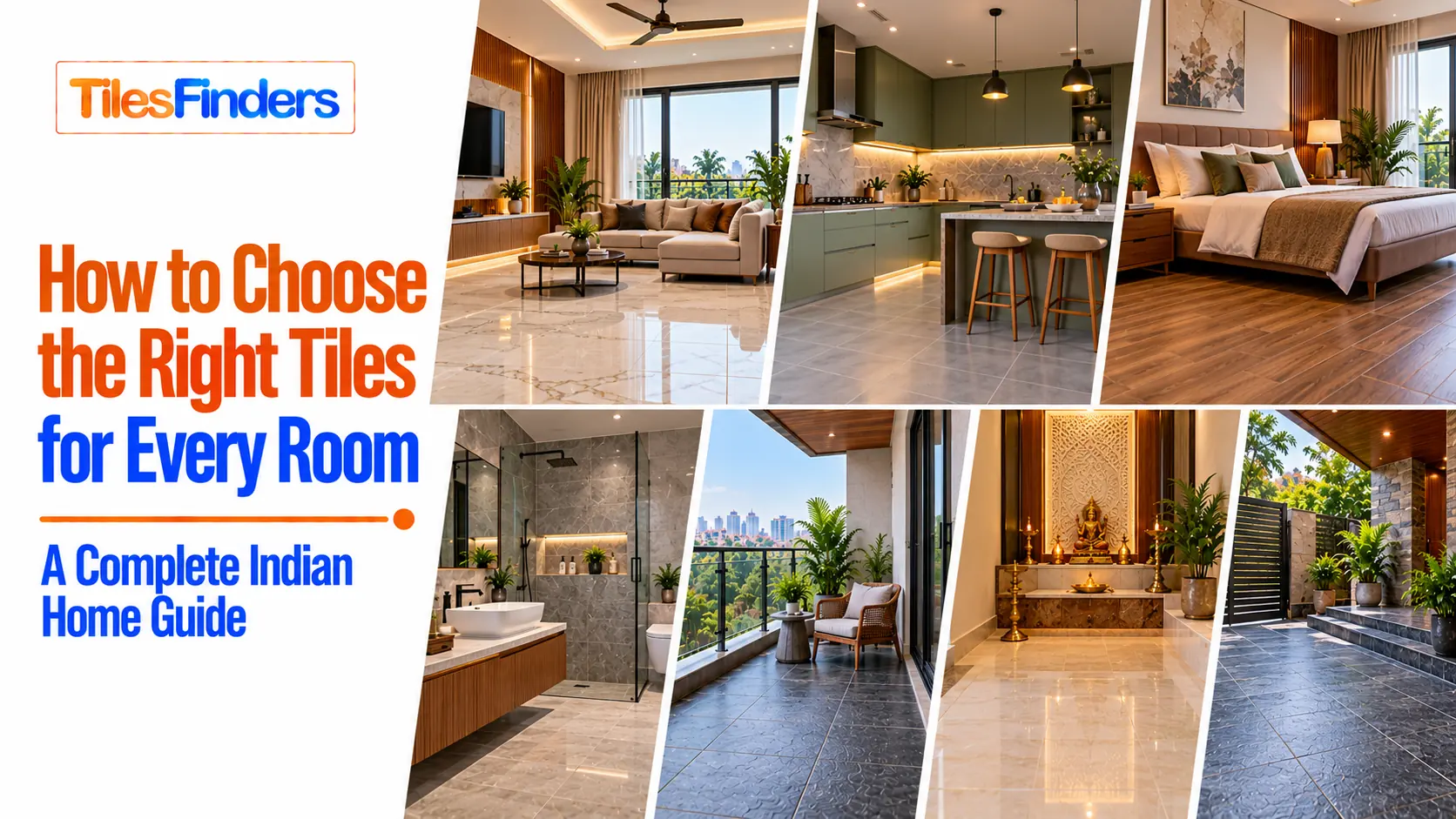
The right tiles for every room come down to one rule: match the tile to the water, the footsteps and the light that room gets. Wet rooms need textured matte floors with a COF (coefficient of friction) of 0.6 or higher, busy rooms need dense vitrified tiles with under 0.5 per cent water absorption, and quiet dry rooms can carry the softer looks you love.
That sounds simple, yet many Indian homes still end up with a glossy bathroom floor, a scratched hall or a balcony that turns green by August. This guide gives a clear verdict for eight rooms, covering tile type, size, finish and a realistic price per sq ft. It comes from how TilesFinders connects Morbi, Gujarat manufacturers with dealers in 200+ Indian cities, so the ranges are typical trade prices, not brochure numbers.
Start with the floor tiles, because a floor takes the heaviest use and is the costliest part to redo. Wall tiles can follow once the floor is fixed.

Three Checks That Decide the Right Floor Tiles for Any Room
Run every room through these checks before you look at a single design.
Wet Floor Tiles Need a Slip Rating Before a Design
Any floor that gets wet needs grip first. Ask for a COF of 0.6 or higher and ask the dealer for the test report instead of a verbal promise. Bathrooms, wash areas, balconies, terraces and parking pads all fall here. A glossy tile that looks perfect in the showroom becomes a skating rink after one splash of soapy water.
Wet areas need textured matte floors. Glossy and polished tiles do not belong on bathroom, balcony or terrace floors, so keep them for dry rooms and walls.
Foot Traffic and PEI Rating for Vitrified Tiles
PEI (Porcelain Enamel Institute) rating shows how well a glazed tile resists scratching and wear, on a scale of 0 to 5. Use PEI 4 for the hall, passages and kitchen, and PEI 3 for bedrooms. Dense vitrified and porcelain tiles handle heavy use because their water absorption stays under 0.5 per cent, the densest group in IS 15622:2006, the Indian standard for pressed ceramic tiles. Ceramic tiles absorb far more water, so they belong on walls. The only floor size we suggest for ceramic is 1×1 ft (300x300mm), and only in dry rooms.
Room Size and Light Decide Tile Size and Finish
Large tiles mean fewer joints, so a room looks calmer and cleans faster. A hall or bedroom of 150 sq ft or more suits 2×4 ft (600x1200mm) tiles, while smaller rooms do better with 2×2 ft (600x600mm) or 1×2 ft (300x600mm) tiles. Light shades push daylight into dim flats, and a matte or semi-polished finish hides footmarks better than mirror gloss. Keep PGVT and satin matte surfaces for walls, never floors, because they mark and wear quickly under footfall.
Room-by-Room Tile Verdicts at a Glance
Use this table as the short version, then read the room sections for the reasoning.
| Room | Best Tile Type | Size | Finish | Price per Sq Ft |
| Living room and dining | Double charge or glazed vitrified | 2×4 ft (600x1200mm) | Matte or semi-polished | Rs. 60 to Rs. 150 |
| Bedroom | Wood look porcelain | 8×48 in (200x1200mm) | Matte | Rs. 55 to Rs. 120 |
| Kitchen floor | Stain-resistant vitrified | 2×2 ft (600x600mm) | Matte | Rs. 40 to Rs. 90 |
| Kitchen wall | Ceramic or porcelain | 1×2 ft (300x600mm) | Glossy or matte | Rs. 30 to Rs. 70 |
| Bathroom floor | Anti-skid vitrified | 1×1 ft (300x300mm) | Textured matte | Rs. 35 to Rs. 85 |
| Bathroom wall | Ceramic | 1×2 ft (300x600mm) | Glossy or matte | Rs. 30 to Rs. 70 |
| Balcony and terrace | Outdoor anti-skid vitrified | 2×2 ft (600x600mm) | Rustic or textured matte | Rs. 35 to Rs. 90 |
| Pooja room | Light vitrified | 2×2 ft (600x600mm) | Matte or semi-polished | Rs. 50 to Rs. 110 |
| Kids room | Wood look or plain vitrified | 2×2 ft (600x600mm) | Matte | Rs. 45 to Rs. 100 |
Prices are typical 2026 trade ranges per sq ft and change with brand, city and batch. The low end usually means a plain, single-colour design, and the high end means a detailed print in a large format. Both ends can last equally long, so pay extra only for a look you will enjoy, not for strength you do not need.
Living Room and Dining Tiles That Handle Daily Traffic
The hall is where guests, children, chairs and mops all meet, so it gets the strongest tile in the house.
Large Format Floor Tiles for the Hall
For a combined living and dining area, living room floor tiles in 2×4 ft (600x1200mm) double charge or glazed vitrified work best. Double charge tiles carry a second layer of pigment, usually about 3 to 4 mm, so small chips show far less than on plain glazed tiles. Pick a matte or semi-polished surface in a soft marble look or plain grey, and keep joints to 2 to 3 mm with colour-matched grout.
A common mistake is a mirror-gloss floor chosen for showroom shine, which shows every dust line by evening. Architects often run one tile through both hall and dining to remove the threshold strip, and dealers can confirm that both areas come from a single batch.
Dining Area and Passage Tiles
Dining areas see dropped curry, chair scrapes and constant mopping, so the hall tile usually works here too. Felt pads under chair legs protect the surface, and a darker plain tile under the table hides sauce marks better than white. Passages and entrance lobbies take the same wear as the hall, so keep PEI 4 there as well.
TV Wall and Accent Tiles Without Glare
A feature wall behind the TV looks best in a textured or 3D look wall tile with a matte surface, because glossy tiles reflect the screen. Limit the feature to one wall and keep the others in plain paint. For wall tiles larger than 2×4 ft (600x1200mm), use a polymer-modified adhesive and a trained fixer, and ask the dealer for the box weight before booking labour.
Bedroom Tiles for Warmth and Quiet
Wood Look Floor Tiles for Bedrooms
Bedrooms are dry, low-traffic rooms where feet are often bare, so a warm look matters as much as strength. In bedrooms,wood look porcelain tiles in 8×48 in (200x1200mm) planks give a calm look and stay easy to mop. PEI 3 is enough here, and a matte surface feels better underfoot than gloss.
Lay the planks with a one-third offset so the printed pattern does not repeat in a line, and order 10 to 15 per cent extra for cuts. Check that the planks in a carton show different print faces, so the floor does not look copied from one pattern. Plank tiles also suit 2BHK flats where one continuous floor makes small rooms feel larger.
Bedroom Wall Tiles Behind the Bed
You rarely need tiles on every bedroom wall. One headboard wall in a soft textured or marble look wall tile adds depth, and the rest can stay painted. Skip dark glossy colours here, because they show dust and make the room feel smaller.
Kitchen Tiles That Survive Oil, Water and Heavy Pots
Matte Kitchen Floor Tiles
A kitchen floor faces oil drops, spilt water and dropped utensils, so choose a matte, stain-resistant vitrified tile in 2×2 ft (600x600mm) at PEI 4. Mid-tone speckled colours hide stains better than white. Treat the area near the sink as a wet area and keep the COF at 0.6 or higher there.
Use 2 mm joints and epoxy grout, which does not soak up turmeric or oil the way cement grout does. If your kitchen has a gas stove and heavy steel vessels, pick PEI 4 and avoid pale glossy tiles, because scratches and grease film show on them within months.
Kitchen Wall Tiles Above the Counter
Between the slab and the chimney, kitchen wall tiles in 1×2 ft (300x600mm) ceramic or porcelain wipe clean in one pass. Glossy tiles clean fastest, while light matte tiles hide water marks. Tile at least 2 ft (600mm) above the counter, and run them to the chimney line behind the hob.
Bathroom Tiles That Stay Safe When Wet
Anti-Skid Bathroom Floor Tiles
Safety beats style here, so bathroom floor tiles must be matte and textured with a COF of 0.6 or higher. Choose 1×1 ft (300x300mm) or 1×2 ft (300x600mm) sizes, because the extra joints add grip and the floor can slope to the drain without awkward cuts. A gentle slope of about 1 in 100 keeps water moving.
Never match a glossy wall tile with a glossy floor tile in a bathroom. A polished floor is the most avoidable cause of bathroom slips.
Bathroom Wall Tiles and Epoxy Grout
For walls, ceramic is the right and cheaper choice. Use 1×2 ft (300x600mm) tiles up to the ceiling in a small bathroom to make it look taller, or at least 7 ft (2100mm) in the shower zone. Light colours help windowless bathrooms.
Use epoxy grout in the shower zone, because cement grout darkens with soap and seepage in monsoon humidity. Waterproofing under the tile stops leaks, so do a 48 hour water-ponding test before tiling. Dealers can supply floor and wall tiles from one colour family so the tones match.
Balcony, Terrace and Parking Tiles for Monsoon and Heat
Balcony Tiles for Rain and Sun
Open spaces need dense, textured tiles, so choose balcony tiles in rustic or textured matte vitrified, in 2×2 ft (600x600mm) or 1×1 ft (300x300mm). Water absorption under 0.5 per cent matters most, because tiles that soak up monsoon rain crack and stain later. You can check it through IS 13630 test methods.
Using an indoor glossy tile on a balcony is the most common error. It turns slick in the first monsoon, and by then the tiles are already fixed. Ask the dealer whether the tile is rated for outdoor use, and keep a 3 mm gap at the wall edge for movement in summer heat.
Terrace and Parking Tiles for Heat and Load
Terraces need a slope of about 1 in 100 and a waterproof layer first. Light-coloured textured tiles reflect heat and keep the slab cooler. For parking, use thick anti-skid tiles of 16×16 in (400x400mm) and ask for the manufacturer’s breaking strength before ordering for cars.
Pooja Room and Kids Room Tiles for Easy Care
Pooja Room Tiles That Clean Quickly
Pooja rooms see water, lamp oil and flower petals, so pick pooja room tiles in a light shade such as white, ivory or beige with a semi-polished or matte surface. A soft marble look in 2×2 ft (600x600mm) gives a calm, clean feel and wipes down in seconds. Avoid deep glossy colours that show every ghee drop.
Kids Room Tiles for Play and Safety
Children drop, spill and sit on the floor, so use matte, slightly textured vitrified tiles in 2×2 ft (600x600mm) at PEI 3 or 4. Wood look planks feel warmer for floor play, and the print hides crayon and food marks better than plain white. Keep joints at 2 mm with epoxy grout so dirt does not collect. A washable rug over the play area keeps bare knees comfortable on a hard floor.
Matching Floor and Wall Tiles Across Rooms
Choosing tiles for every room does not mean choosing a different style for every room. A home feels calm when the tiles share a small colour family, so many designers pick one warm or cool base, such as grey, beige or ivory, and vary only the finish and size room by room.
Colour Families and Transitions Between Tile Floors
Run the hall, dining and bedroom passage in one tile, then change to a different tile only at a door or a natural break. Where two floor tiles meet, a thin metal or stone strip hides the joint cleanly. For wide spans of 10 m or more, architects usually plan an expansion joint so the tiles do not tent in summer heat.
Tile Levels and Thresholds Between Wet and Dry Rooms
Bathroom and balcony floors should sit about 1 inch (25mm) below the room floor, so water stays inside instead of creeping into the bedroom. Ask the mason to plan these levels before the tiles arrive, since a wrong level cannot be fixed by changing the tile.
Tile Budget for a 2BHK: Where to Spend and Where to Save
Here is an illustrative budget for the tiles for every room of a 2BHK flat, using mid-range prices from the table above. A hall and dining area of 250 sq ft at Rs. 90 comes to Rs. 22,500. Two bedrooms of 120 sq ft each at Rs. 75 add Rs. 18,000. An 80 sq ft kitchen floor at Rs. 60 costs Rs. 4,800, and two bathroom floors totalling 80 sq ft at Rs. 55 cost Rs. 4,400, which brings floor tile material to about Rs. 49,700.
Wall tiles add roughly 400 sq ft in the bathrooms and 40 sq ft in the kitchen, and at Rs. 45, that is another Rs. 19,800, so the total is near Rs. 69,500 before wastage and labour. Spend more on the hall floor, because it is seen daily and takes the most wear. Save on kids’ room and guest bedroom tiles, where a plain matte vitrified tile does the job. Never save on bathroom and balcony slip rating, since a fall costs far more than the price gap between tiles.
Ordering Tiles: Quantity, Batch Number and Dealer Checks
Tile Quantity and Wastage by Room
Before ordering tiles for every room, measure each room in sq ft and add 5 to 7 per cent for straight laying and 10 to 15 per cent for diagonal or plank patterns. A 2×2 ft (600x600mm) carton usually holds four tiles, about 15.5 sq ft, so ask the dealer for carton coverage. Keep one spare carton for future repairs, because the same design may be discontinued in three years.
Batch Numbers and Stock Checks for Tiles
Every carton prints a batch number, and tiles from different batches can differ slightly in shade. Make sure all cartons for one room carry the same batch. A large share of India’s vitrified tiles comes from Morbi, Gujarat, so freight to far cities adds cost and days. Confirm stock in your pincode before you fall for a design.
Fixing and Cleaning Floor and Wall Tiles After You Buy
Tile Adhesive, Joints and Curing Time
Even the right tiles fail when they are fixed badly. Use polymer-modified tile adhesive for large-format floor tiles and for all wall tiles, and spread it on both the surface and the back of the tile so no hollow spots remain. Tap each tile after fixing, because a hollow sound means trapped air and a future crack. Keep joints at 2 to 3 mm and let the floor cure for 24 to 48 hours before anyone walks on it.
Daily Cleaning for Matte and Polished Tiles
Mop matte floor tiles with a neutral cleaner and plain water, and avoid acid-based bathroom cleaners on polished tiles and on joints, because acid dulls the surface and eats cement grout. In the monsoon, wipe balcony and entrance tiles dry so mud does not stain the textured surface. A soft brush clears dirt from anti-skid bathroom floors every week and keeps the grip working as designed.
Whole-Home Tile Choices Without Eight Showroom Visits
By now you know what each room needs. The tiring part is turning that into a shortlist, usually across several weekends of showroom visits, where the design you loved turns out to be unavailable near you.

That is why every design on TilesFinders is shown only if a dealer in your pincode can supply it. A bathroom shortlist and a hall shortlist can be built in one sitting, and you walk into the shop already knowing the tile, size and finish to ask for.